
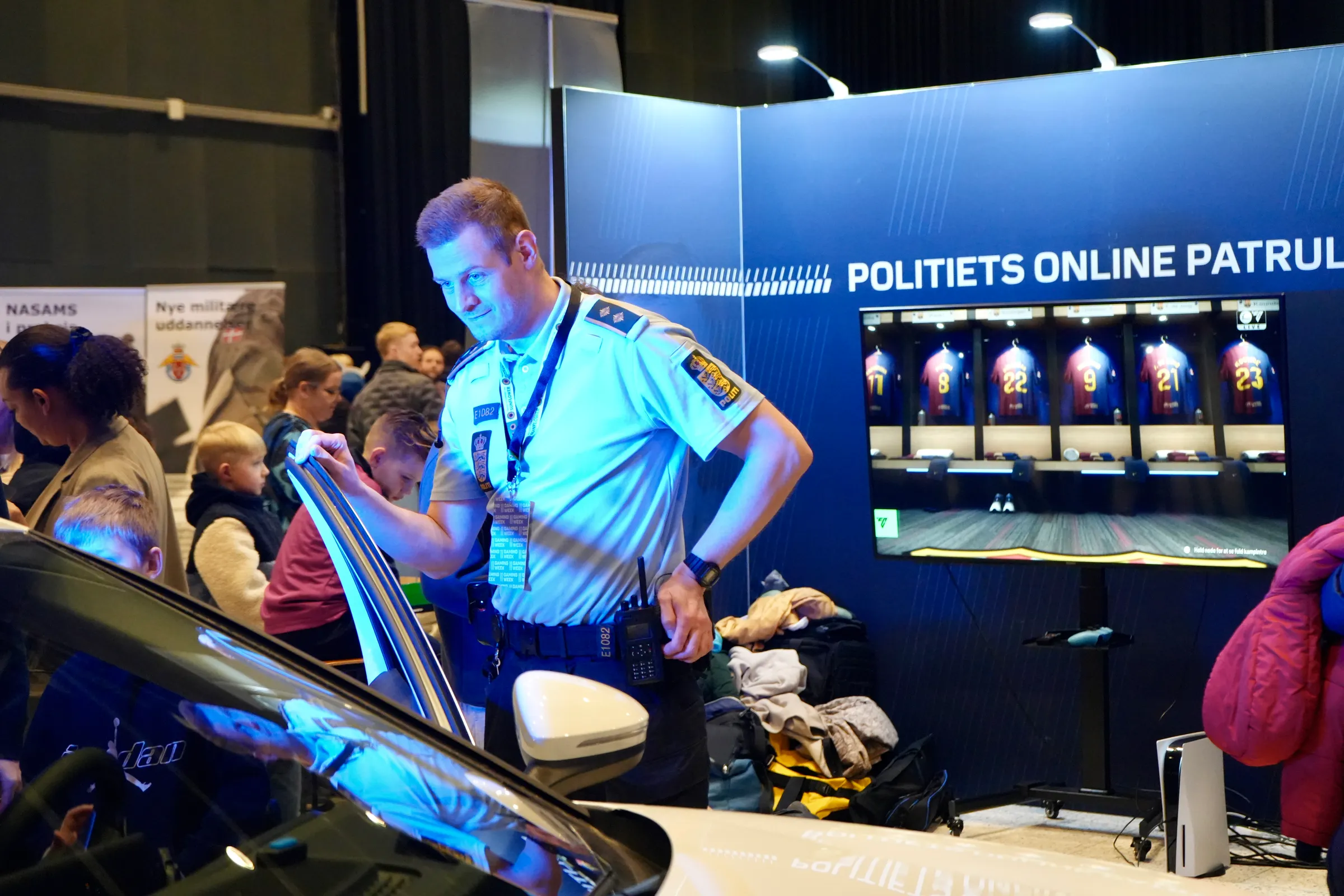

The local officer has always played football with the young people at the club. Now, he also sits down to game — everything from FIFA to Counter-Strike and Fortnite — and according to the police themselves, the logic is exactly the same.
At Copenhagen Gaming Week, Mikkel Aalund Olsen moves around among the stands. He is a police assistant at the National Unit for Special Crime (NSK) and part of the Police's Online Patrol under the National Center for IT Crime (NCIK). He is not here to enforce the law. He is here to show that the police take the gaming community seriously — and that in itself is a quiet revolution.
Acknowledgment Without Words
The Police's Online Patrol does not officially call themselves advocates for esports. They do not declare gaming as a sport on par with football and handball. But their mere presence sends a signal that is hard to misunderstand.
"Our local officers go out and play football and show up at clubs and sit and chat. In the same way, we must also ensure that the young people who spend most of their time online also have officers who are there for them."
— Mikkel Aalund Olsen, police assistant, NSK
That parallel is central. When the police show up at a football club, no one questions it. When they show up in a gaming space, it still challenges a prejudice — and that is precisely the point. By treating online communities with the same seriousness as physical ones, the police legitimize a culture that has long been dismissed as mere pastime.
Community as Prevention
Behind the symbolic recognition lies a very concrete professional argument. Mikkel points to the research without hesitation.
"Positive communities are a huge positive factor in avoiding, for example, radicalization. We know that healthy networks are enormously important for children's well-being and development. And children who thrive are always less criminal than those who do not. That science cannot be disputed."
It is a point that turns the stigmatization of gaming on its head. While public debate often focuses on the risks of screen time, the police point to the opposite: that online communities can be crucial for precisely those children and young people who do not find belonging in traditional arenas.
"Online communities can provide some people, who might not otherwise have found anyone to share a community with, exactly that, and it is crucial."
More Than Games — and More Than Talk
The Police's Online Patrol was established as part of the police's multi-year agreement, inspired by similar initiatives in Norway. Every Wednesday afternoon, they stream on Twitch, where children and young people can ask questions in an open forum — almost without restrictions.
"We create a safe space where children and young people can talk to an officer and see an officer in a way they might not be used to. They get to see an officer who has time for them, who is ready to tackle difficult questions in a non-dramatic way."
But the actual gaming time is surprisingly small. Mikkel estimates that only five percent of working time is spent with the controller. The rest is about patrolling social media, the internet, and producing content, school presentations, and collaborating with several NGOs such as Save the Children and Children's Welfare.
The Skepticism That Reveals the Stigma
But not everyone sees it that way. Mikkel is familiar with the objections.
"Are you just spending your work hours playing video games?"
It is worth dwelling on that skepticism. Because it is not just about the police's priorities — it reveals something about how gaming is still perceived in society. No one would ask the equivalent question to a local officer who spends an afternoon playing football with young people in a club. But when the screen replaces the grass, suspicion arises automatically: is this really work?
That is precisely the prejudice that the gaming community itself faces. And it is here that it becomes interesting that it is NSK — the National Unit for Special Crime, the heaviest crime unit in Danish police — that chooses to take up the fight. When a unit that investigates and combats the most serious and complex crime in Denmark, including organized crime, economic crime, and cybercrime, defends the value of the gaming community with professional arguments about prevention and well-being, it is a legitimization that no esports organization could create on its own.
Mikkel acknowledges that perception is a constant challenge.
"How much should we insist that the police be a completely rigid institution that you write to, and then you get a reply six weeks later with a polite letterhead? We want to show that the police are an organization that dares to step forward and show some humanity — and that you can still be professional."
And then the football parallel returns. When an officer goes out to a youth club and kicks a ball, it builds relationships and security. When an officer logs on to Twitch and plays with children, it does exactly the same — just in the space where a growing part of the young generation actually is. That one still requires a defense while the other is self-evident says more about society's prejudices than about the police's priorities.
The Dark in the Light
However, Mikkel is not naive about the risks. Platforms like Roblox, in particular, require attention, he points out.
"Roblox is a game where many children play, but it is not a children's game. It is a large, open network where children can be exposed to almost anything because it is very user-driven. It is never out of malice that parents do not know this. They may just not have been aware."
And it is precisely here that the patrol's role as a mediator becomes clear. Not just for the children, but for the parents and educators — the adults who need to make informed choices about what their children spend time on.
A Signal to an Entire Generation
The Police's Online Patrol is ultimately about more than prevention and investigation. Their mere existence is a signal: that the digital communities, which millions of young Danes are part of, deserve to be taken as seriously as any other arena where people meet.
"The police must meet citizens where they are. And there is just a very, very large part of the population that spends a lot of time online."
When an officer in uniform sits down at a screen at Copenhagen Gaming Week, it is not just a PR stunt. It is an institution saying: This community is real. It has value. And we are here.